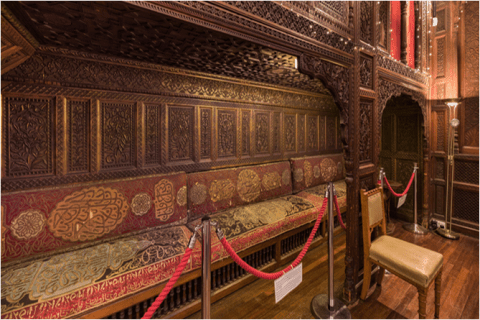
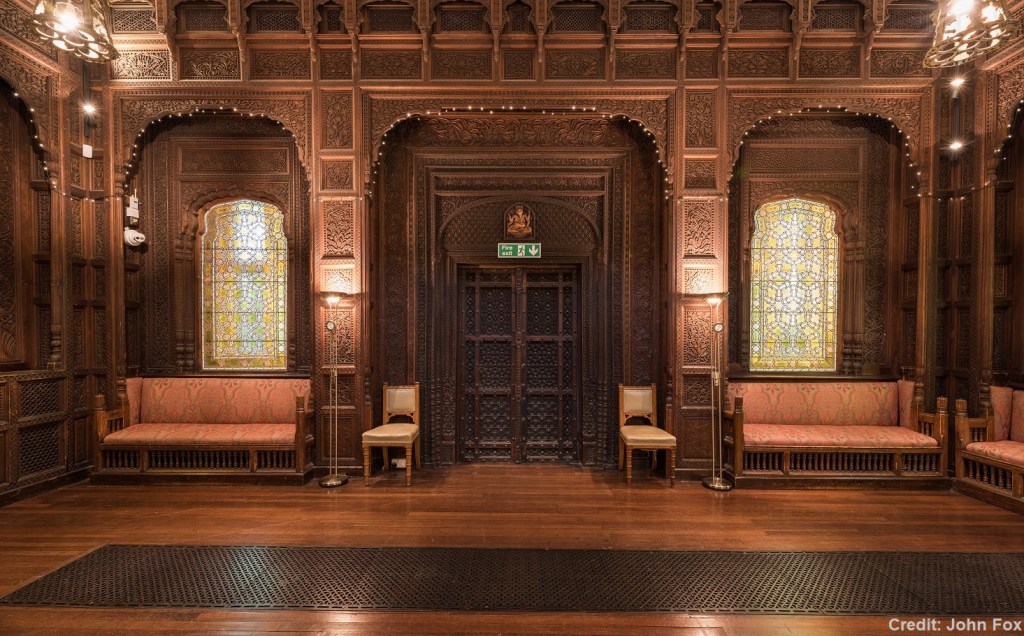
Anybody who has visited the Durbar Hall in the Museum can’t have failed to notice the banquettes shown in the photo above.
The banquettes have been well used over the years and are now in a very poor state. If we don’t take action soon, the material may deteriorate too far to be repaired. This type of work is very specialist and beyond the budgets available to the Museum. The total cost is likely to be in excess of £18,000.
Please donate generously
We are, therefore, inviting you to donate as generously as you can to raise funds to pay for this work. By helping to fund this conservation work, you will be helping the museum to preserve a rare example of craftwork of this kind as well as an important part of the Durbar Hall furnishings in their original condition.
How to donate
By cheque payable to ‘Hastings & St Leonards Museum Association’ sent or delivered to the Museum
By PayPal by clicking on this link to our account
If you have any problems, please email HStLMuseumAssoc@gmail.com
We would like to publish the names of donors but not the amount donated so please indicate when donating if you are happy for your name to be published.
Donations received via the Museum’s Crowdfunder appeal last year, remain in that pot and will be added to whatever we can raise.
We have produced A4 posters and A5 flyers. If you are able to display a poster or distribute flyers for the fundraiser, please email us. There is also a PowerPoint presentation which you can download here.
History
The banquettes were originally created for the Colonial & Indian Exhibition held in South Kensington, London, in 1886. After the Exhibition, the banquettes were re-upholstered by Lord and Lady Brassey, when the Hall was moved to their Park Lane mansion. The material they used was bought in Cairo by Annie Brassey on one of her early trips. The embroidered patterns include random Arabic letters set within stylized cartouches and bordered with foliate and graphic motifs. The designs are made from panels of silk and richly embroidered with metallic threads.
Thanks to Erica Barrett, we now have some more information about the upholstery of the banquettes from Tim Stanley of the V&A.
“These textiles were produced in Cairo for the tourist market in the late 19th or early 20th century. So far there has been no study of them (and the V&A does not own any examples), but I am pretty sure that they are linked to the production of the (often huge) dressings for the Ka’bah and other significant sites in the Two Noble Sanctuaries (Mecca and Medina), which are changed every year.
These embroidered textiles were prepared in Egypt for many hundreds of years until the Saudis took over in the mid-20th century, and so when European tourism to Egypt on a large scale began in the 19thcentury, it occurred to someone that they could sell similar work to the visitors. But of course, they had to change the colours and the nature of the inscriptions – you couldn’t have quotations from the Qur’an and other Islamic religious inscriptions circulating among the non-Muslim customers. This is particularly the case with these banquette covers, where people would have sat on the inscriptions.
The inscriptions are not alternative, non-religious texts. They are just jumbles of letters that look like inscriptions.”
 Hastings & St Leonards Museum Association